


Opinion Editorial May, 2026: For All Humanity
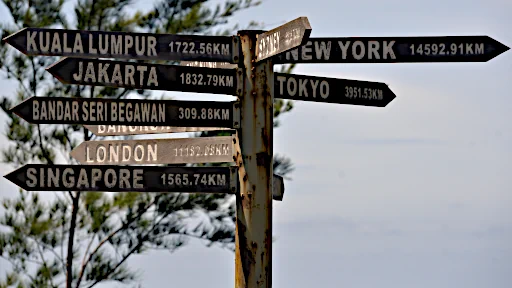
I have visited most of the places on this sign post as well as many places in between those places. While I haven't seen all of humanity, I have been within a few thousand kilometers of most of the world's population. Those travel experiences tell me that human differences, even just among indigenous people, are so profound that nothing could ever be undertaken for all humanity.
Take politics. We've tried dozens of systems. Democracy showed some promise for a while, but it is waning in popularity. So, nobody was surprised last month when Ibrahim Traoré, president of Burkina Faso, said that his country would not transition to democracy any time soon. In contrast, democracy had been progressively eroded in Hungary for sixteen years. But some were surprised last month when Viktor Orbán was ousted as prime minister. His successor, Péter Magyar, is already promising the restoration of democracy there. Even in Gaza there was a faint presence of democracy last week.
A similar analysis could be undertaken for cultural norms, social organizations, religions etc.
"For All Humanity" was the moniker of last month's Artemis II lunar flyby. It replaced the Apollo-era "For All Mankind." Almost technically flawless, the mission also shined with irony.
The first non-American to travel to the Moon, Jeremy Hansen, represented Canada's minority francophones by speaking their language in space. He also represented his country's indigenous people by wearing a personal mission patch laden with symbols of indigenous knowledge and designed by Anishinaabe artist Henry Guimond. The first non-white astronaut to travel there, Victor Glover, reminded us that we are all one people belonging to the same species. Around the same time, his ultimate boss was threatening to annihilate one of the world's oldest human civilizations.
We now live in a world where crimes against humanity are ostensibly being perpetrated on behalf of humanity and the word 'ceasefire' is an oxymoron. The key to understanding this paradox may lie in the history of our speciation.
Last month, scientists published the results of a longitudinal (twenty-year) observation of a group of wild chimpanzees — our closest cousins on the evolutionary tree. Over the first two years the group split into two rival groups. One of those groups has since killed at least 28 members of the other group. It is not known why this happened but it is believed to be the first time it has ever been observed. If there were laws of the jungle, it could be called crimes against chimpanzees.
Similar behavior has been documented in human groups. For example, the Huaorani people have a well-documented history of intratribal warfare.
No scientific conclusions should be drawn from any one study — especially a comparative one. But the observations of wild chimpanzees open up the possibility that our predisposition to violence against each other may have been etched into our genetic makeup around eight million years ago. If so, that was the last time anything happened for all humanity.
If you enjoyed reading this month's opinion editorial, please consider supporting independent, advertising-free journalism by buying us a coffee to help us cover the cost of hosting our web site. Please click on the link or scan the QR code. Thanks!